A Proven Strategy for Generating 10,000+ Monthly Website Visitors Using Push Notifications
By Editorial Team |
Are you seeking effective methods to increase visitor numbers on your website?
Consider this possibility:you could potentially attract hundreds or even thousands of returning visitors to your site each month through a straightforward approach.
This might appear overly optimistic, particularly when traditional traffic sources like search engine optimization demonstrate increasing volatility. However, this approach has demonstrated consistent results for many website owners.
A significant limitation of most traffic generation methods, including search engines and social media platforms, involves the lack of control over their underlying algorithms.
To establish a reliable stream of website visitors, you need a traffic source that you can manage directly.
One solution that has proven effective for numerous WordPress professionals involves push notification technology. This approach provides direct communication channels with your audience and enables visitor re-engagement without dependence on unpredictable external algorithms.
Many experienced developers have observed how strategic implementation of push notifications can deliver consistent returning traffic. Through careful application, websites can add substantial numbers of repeat visitors each month.
This article explores practical applications of push notifications, demonstrates achievable results, and provides guidance for implementing this strategy on WordPress platforms. These insights can help website owners establish greater control over their traffic patterns and expand their audience reach.
Establishing Controlled Traffic Sources for Consistent Visitor Growth
Website administrators have experimented with various approaches to create reliable, controllable traffic sources. Several strategies have demonstrated effectiveness:
- Developing email subscriber lists
- Creating mobile applications
- Building notification subscriber networks
Each approach presents distinct advantages and limitations, but push notifications frequently emerge as the most straightforward method for generating consistent traffic. Many successful websites report adding approximately 10,000 additional monthly visitors through this strategy.
1. Email List Development
Email marketing represents one of the most established methods for driving repeat website traffic. Numerous service providers offer tools for initiating email campaigns, typically with tiered pricing structures that include introductory trial periods.
While email list building remains a recommended strategy, it requires both financial investment and consistent time allocation for creating engaging content. For those seeking alternatives, other options may prove more practical.
2. Mobile Application Development
While mobile applications might seem appealing, they often prove impractical for most websites unless operating at enterprise scale. Realistically, most visitors will not download dedicated applications, and those who do frequently remove them shortly after installation.
Additionally, application development requires substantial financial investment and ongoing maintenance resources. For those considering this path, WordPress offers plugins that can facilitate website-to-application conversion.
3. Notification Subscriber Lists
Push notifications provide the most accessible and cost-efficient method for building subscriber networks. This approach enables audience re-engagement without the content creation demands of email marketing, offering a direct pathway to reconnect with previous visitors.
Compared to email lists, push notification systems require minimal financial investment and administrative effort while delivering substantial results.
Understanding Push Notification Technology
Push notifications consist of brief, actionable messages delivered directly to users' web browsers. Visitors voluntarily opt into receiving these communications, creating direct re-engagement channels.
Based on widespread implementation experience, these notifications effectively disseminate updates and drive returning traffic. When visitors access a website, they can encounter subscription prompts through modal interfaces. Following subscription, they receive timely updates via push notifications.

Most internet users have encountered push notifications on mobile devices.
These compact messages appear on device screens, encouraging website or application visits.
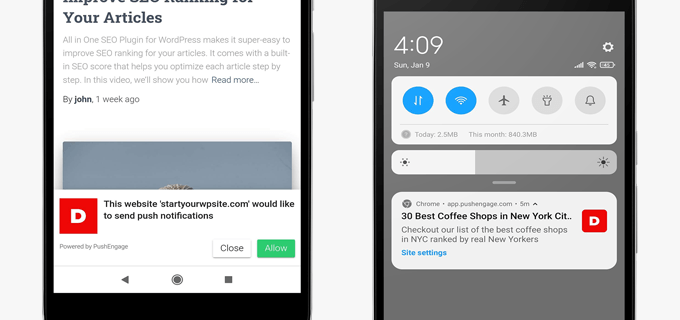
These communications offer extensive customization and personalization capabilities, making them particularly effective at capturing attention and encouraging repeat visits. Minor adjustments to notification content can significantly impact user engagement levels.
Implementing push notifications typically involves utilizing specialized service platforms. These services streamline subscription management, message distribution, and automated communication processes.
Through audience segmentation and message automation, website administrators can ensure timely, relevant notifications that maximize traffic generation effectiveness.
Advantages of Push Notifications for Traffic Growth
Contemporary digital marketers face increasing challenges in capturing audience attention amid overwhelming content volumes.
Push notifications provide competitive advantages through cross-platform compatibility and device versatility. These targeted communications prove highly effective at driving user return rates.
Key benefits of implementing push notifications on WordPress websites include:
- Subscriber Growth Without Personal Data Collection– Unlike email or SMS marketing, push notification subscriptions require no personal information collection. This approach addresses growing online privacy concerns among users.
- Accelerated Subscriber Acquisition– With average opt-in rates exceeding 6%, push notifications demonstrate significantly higher engagement rates than alternative methods, particularly when compared to email marketing's approximate 3% opt-in rate.
- Repeat Traffic Generation– Most first-time visitors (approximately 95%) do not immediately convert to customers. Push notifications effectively encourage return visits, gradually moving visitors toward conversion decisions.
- Superior Click-Through Performance– Push notifications achieve average click rates around 28%, substantially exceeding email marketing's 1-2% range. This represents a more effective method for capturing user attention and driving website returns.
- Immediate Response Generation– While email responses typically require 6.5 hours or more, push notifications often generate immediate reactions by capturing attention during active browsing sessions.
- Simplified Implementation and Management– Push notification systems prioritize user-friendly interfaces, making them accessible to marketers without advanced technical expertise.
- Cost-Effective Marketing Solution– As an economical alternative to traditional marketing methods, push notifications provide accessible solutions for organizations of varying sizes.
Let's examine practical implementation approaches for push notification systems.
Effective Push Notification Implementation Strategies
Many WordPress professionals utilize specialized push notification platforms to maintain visitor engagement beyond initial site visits.
These platforms offer several advantages:
- User-friendly interfaces that simplify campaign creation and scheduling for users at all experience levels
- Advanced segmentation and personalization capabilities for targeted message delivery
- Support for multiple campaign types, automated responses, retargeting features, and additional engagement tools
Successful implementation focuses not only on traffic generation but also on maintaining positive user experiences through non-intrusive notification practices.
Effective strategies prioritize notification relevance, efficiency, and value delivery, enhancing engagement while improving return on investment.
Common notification types that support these objectives include:
Two-Step Subscription Notifications
Website administrators can implement two primary subscription interface types. Single-step opt-in systems provide basic functionality but often suffer from visitor disregard due to overexposure across numerous websites.
Users encounter these subscription requests so frequently that they develop notification blindness.