3 Effective Methods for Deploying WordPress on Google Cloud Platform
When exploring WordPress hosting options on Google Cloud, many website owners recognize the potential for significant performance improvements.
The prospect of utilizing the same infrastructure that supports major Google services presents exciting opportunities, though it often raises practical questions about implementation.
Through comprehensive evaluation, three distinct approaches emerge for hosting WordPress on Google Cloud: utilizing a managed hosting provider, deploying through Google Cloud Marketplace with simplified installation, or configuring a manual setup on a virtual machine.
Google Cloud delivers impressive speed and reliability, but the do-it-yourself approach requires technical expertise that may challenge beginners. Managing virtual machines, configuring servers, and handling DNS settings can present obstacles for those without system administration experience.
The encouraging news is that multiple pathways exist to leverage Google Cloud's capabilities. This guide examines all three methods, enabling readers to select the approach that aligns with their technical proficiency and project requirements.
By the conclusion, you'll understand how to implement WordPress on Google Cloud and receive practical recommendations based on real-world implementation experience.
Benefits of WordPress Hosting on Google Cloud
Google Cloud Platform represents a comprehensive suite of cloud computing services offering infrastructure, storage, and computational resources on demand. Since its introduction, this platform has supported numerous high-traffic applications and services.
The platform is recognized for its speed, stability, and robust infrastructure designed to manage substantial traffic volumes without performance degradation.
Many website administrators consider whether hosting WordPress on Google Cloud will deliver comparable performance to major applications running on the same infrastructure.
In principle, this is achievable. However, there exists a significant distinction between accessing Google Cloud services and effectively configuring them for WordPress optimization. The situation resembles possessing advanced technology without the expertise to maximize its potential.
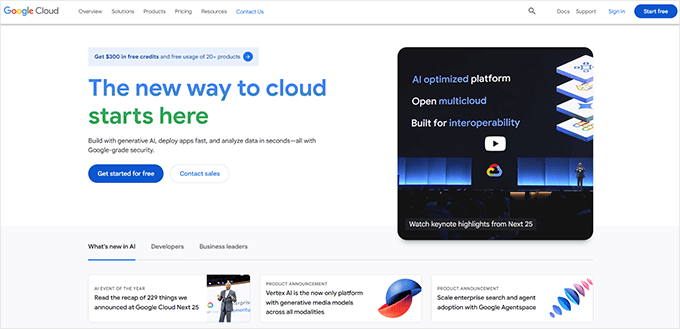
This represents the primary challenge for many users. While the platform offers exceptional capabilities, its design caters to engineering professionals rather than WordPress users focused on content creation and audience development.
If you're evaluating whether Google Cloud represents the optimal choice for your WordPress site, you're considering a question many website owners face.
The following section presents the most accessible approach to leveraging Google Cloud's capabilities without manual configuration requirements.
Subsequent sections will explore two hands-on implementation methods for those preferring greater technical control.
Navigation links are provided for direct access to specific sections:
- Method 1: Managed WordPress Hosting on Google Cloud
- Method 2: Google Cloud Marketplace WordPress Deployment
- Method 3: Manual WordPress Installation on Google Cloud VM
- Google Cloud Hosting Cost Considerations
- Implementation Recommendations
- Common Questions About WordPress on Google Cloud
- Additional WordPress Hosting Resources
Method 1: Managed WordPress Hosting on Google Cloud
For those seeking Google Cloud's performance advantages without technical configuration responsibilities, managed WordPress hosting represents a recommended solution that many experienced users implement.
Numerous WordPress professionals have reported improved page loading speeds and consistent performance during traffic fluctuations after transitioning to managed hosting solutions built on Google Cloud infrastructure.
One industry expert noted:
After evaluating multiple hosting platforms and observing how effectively managed solutions handle practical demands, the decision to utilize Google Cloud infrastructure through a managed provider became clear.
Industry Expert
Managed hosting providers operate their platforms on Google Cloud infrastructure, delivering comparable performance without requiring users to manage technical aspects.
Users avoid server configuration, software installation, and update management responsibilities. Performance optimization, security measures, and maintenance tasks are handled by the provider. The process involves logging into the hosting dashboard, installing WordPress, and beginning website development.
Managed hosting solutions typically offer user-friendly interfaces with comprehensive features including automatic caching, content delivery network integration, regular backups, security implementations, and staging environment creation.
Advantages of Managed Hosting
- Utilizes Google Cloud's performance and reliability infrastructure
- Eliminates technical configuration requirements
- Provides customer support with WordPress expertise
- Includes caching, backups, security, and CDN functionality
- Features predictable monthly pricing structures
Considerations for Managed Hosting
- May not provide complete server-level control for custom configurations
- Advanced developers might prefer direct cloud management for specialized applications
Pricing Structure: Unlike Google Cloud's consumption-based pricing, managed hosting typically offers fixed monthly rates starting at competitive price points.
For website owners prioritizing development over server management while maintaining performance and security standards, this approach represents the most straightforward implementation method.
Method 2: Google Cloud Marketplace WordPress Deployment
Google Cloud Marketplace provides pre-configured WordPress solutions that simplify deployment through guided installation processes.
This approach balances accessibility with greater control than fully managed hosting, offering a middle ground for users comfortable with basic cloud management while avoiding complete manual configuration.
The Marketplace features various WordPress configurations, including standard installations and optimized stacks with caching and security components pre-installed.
Implementation Process Overview
Begin by accessing Google Cloud Console and navigating to the Marketplace section. Search for WordPress solutions and select an appropriate deployment option based on your requirements.
The deployment wizard will guide you through configuration steps including region selection, machine type specification, and storage allocation. Following configuration, the system automatically provisions resources and installs WordPress with necessary components.
Upon completion, you receive access credentials and connection details for your WordPress installation.
Advantages of Marketplace Deployment
- Simplified installation process with guided configuration
- Pre-configured environments with optimized settings
- Direct Google Cloud resource management
- Flexibility in resource allocation and scaling
Considerations for Marketplace Deployment
- Requires basic understanding of cloud resource management
- Responsibility for ongoing maintenance and updates
- Consumption-based pricing requires monitoring
Method 3: Manual WordPress Installation on Google Cloud VM
Manual WordPress installation on Google Cloud virtual machines provides maximum control and customization potential for technically proficient users.
This approach involves creating a virtual machine instance, configuring the operating system, installing necessary software components, and deploying WordPress manually.
The following comparison illustrates differences between manual and automated deployment approaches:
| Feature | Manual VM Setup | Marketplace Deployment |
|---|---|---|
| Ease of Use | Requires Linux experience and command line proficiency | Simplified with configuration wizard guidance |
| Installation Speed | Extended timeframe for manual configuration | Accelerated with automated installation processes |
| Customization | Complete control over software and server configurations | Limited to predefined environment parameters |
| Educational Value | Comprehensive understanding of system architecture | Focused on deployment rather than deep system knowledge |
| Maintenance Responsibility | Complete user responsibility for all maintenance | User responsibility with some automated tools |
| Primary Use Case | Developers, technical professionals, or testing environments | Users seeking direct cloud management with reduced configuration complexity |
Manual Implementation Overview
The manual process begins with creating a Compute Engine instance in Google Cloud Console. Select an appropriate machine type, operating system (typically Ubuntu or Debian), and configure storage and networking options.
Following instance creation, connect via SSH to install necessary components including web server software (Apache or Nginx), database server (MySQL or MariaDB), and PHP with required extensions.
After configuring the software stack, download and install WordPress, configure database connections, and implement security measures including firewall rules and SSL certificates.
Advantages of Manual Installation
- Complete control over all system components
- Optimization for specific performance requirements
- Custom security implementations
- Deep understanding of system architecture
Considerations for Manual Installation
- Requires substantial technical expertise
- Time-intensive configuration and testing
- Ongoing maintenance responsibility
- Potential for configuration errors without proper knowledge
Google Cloud Hosting Cost Considerations
Understanding Google Cloud pricing structures is essential for effective budget management when hosting WordPress.
Google Cloud utilizes consumption-based pricing for most services, with costs determined by resource utilization including compute instances, storage, network egress, and additional services.
Compute Engine instances represent the primary cost component, with pricing varying based on machine type, region, and sustained usage. Storage costs accumulate based on allocated disk space and snapshot requirements.
Network egress charges apply to data transferred out of Google Cloud, which can become significant for high-traffic websites. Additional costs may include load balancing, managed database services, and monitoring tools.
Google Cloud offers a free tier with limited resources and sustained use discounts for continuous instance operation. Budget alerts and spending limits help prevent unexpected charges.
For predictable budgeting, many users prefer managed hosting solutions with fixed monthly pricing that includes all necessary resources and support services.
Implementation Recommendations
Selecting the appropriate WordPress hosting method on Google Cloud depends on technical proficiency, resource requirements, and management preferences.
For most website owners, managed WordPress hosting provides the optimal balance of performance, security, and convenience. This approach eliminates technical complexities while delivering Google Cloud infrastructure benefits.
Users with basic cloud management skills seeking greater control may prefer Marketplace deployment, which offers simplified installation with direct resource management capabilities.
Manual installation suits technically proficient users requiring complete system control for specialized applications or development environments.
Regardless of the selected approach, regular monitoring, security updates, and performance optimization remain essential for maintaining WordPress site functionality and user experience.
Common Questions About WordPress on Google Cloud
What technical skills are necessary for manual WordPress installation on Google Cloud?
Manual installation requires familiarity with Linux command line operations, web server configuration (Apache/Nginx), database management (MySQL/MariaDB), PHP configuration, and basic networking concepts including DNS and firewall configuration.
How does Google Cloud performance compare to traditional shared hosting?
Google Cloud typically delivers superior performance through scalable resources, global infrastructure, and optimized networking. However, effective configuration and optimization are necessary to realize these advantages fully.
What security considerations are important for WordPress on Google Cloud?
Essential security measures include regular software updates, firewall configuration, SSL certificate implementation, secure database practices, and monitoring for suspicious activity. Managed hosting providers typically include comprehensive security features.
Can existing WordPress sites migrate to Google Cloud?
Yes, migration involves transferring files, exporting/importing databases, and updating configuration settings. Many managed hosting providers offer migration assistance, while manual migration requires technical expertise.
Additional WordPress Hosting Resources
For those implementing WordPress on Google Cloud, numerous educational resources provide guidance on optimization, security implementation, and performance monitoring.
Technical documentation from Google Cloud offers comprehensive information on service configuration and management. WordPress community resources provide platform-specific guidance for various implementation scenarios.
Performance optimization techniques include caching implementation, image optimization, database tuning, and content delivery network utilization. Security best practices encompass regular updates, strong authentication methods, and monitoring solutions.
Regular evaluation of hosting performance and costs ensures optimal resource utilization and identifies opportunities for improvement based on evolving website requirements.